
Vietnam women's team kata wins 5-0 at the Asian Games: Decoding a unanimous verdict
core_answer: Đội kata đồng đội nữ Việt Nam gồm Nguyễn Ngọc Trâm, Bùi Ngọc Nhi và Hoàng Thị Thu Uyên giành huy chương vàng Asiad sau khi cả năm giám khảo chấm 5–0 trước Iran. Đây là tấm vàng đầu tiên của đoàn Việt Nam. Kết quả đồng thuận tuyệt đối phản ánh mức đồng bộ vượt trội, không phải một cuộc đối kháng có tiếp xúc.
key_facts: Kết quả: Việt Nam 5–0 Iran ở chung kết kata đồng đội nữ; cả năm giám khảo chấm Việt Nam cao hơn.; Đây là huy chương vàng đầu tiên của đoàn Việt Nam tại kỳ đại hội châu lục này.; Nguyễn Ngọc Trâm bị sưng và trầy đầu gối trong khởi động, vẫn thi đấu ở chung kết.; Ba vận động viên nắm tay, điều chỉnh nhịp thở trong lúc chờ Iran hoàn thành bài thi.; Khoản thưởng khoảng 1,2 tỷ đồng, đến từ nguồn nhà nước và nguồn xã hội hóa.
source_attribution: Nguồn: Hồ sơ phân tích chuyên môn Stage-2 về chung kết kata đồng đội nữ, công bố ngày 8 tháng 10 năm 2023 | Cross-checked: VuaBong.vn
related_qa: question: Kata đồng đội khác kumite ở điểm nào?, answer: Kumite là đối kháng có tiếp xúc, chấm theo đòn đánh hợp lệ; kata là bài quyền trình diễn theo nhóm, do hội đồng giám khảo chấm theo tiêu chí kỹ thuật và thể chất.; question: Tỷ số 5–0 có nghĩa Việt Nam vượt trội tuyệt đối?, answer: Nó xác nhận cả năm giám khảo đồng thuận đặt Việt Nam cao hơn, nhưng không lượng hóa khoảng cách vì điểm theo từng tiêu chí không được công bố.; question: Vì sao huy chương này đặc biệt quan trọng với karate Việt Nam?, answer: Karate không còn trong chương trình Olympic Paris 2024 và Los Angeles 2028, nên đấu trường châu lục trở thành cửa sổ hiển thị chính của môn này.
Three athletes stood outside the competition area, hands locked together in a single block, eyes closed, their breathing pulled into one shared rhythm. Inside, Iran had just finished its team routine. Nguyen Ngoc Tram later recalled that the trio was so tense that none of them dared speak during the wait for the score. Minutes earlier, during the warm-up, her knee had struck the floor twice; the swelling and the abrasion were still there when she stepped out to compete alongside Bui Ngoc Nhi and Hoang Thi Thu Uyen.
The scoreboard read: 5-0. Five judges, five ballots, every one of them placing Vietnam above Iran in the women's team kata final.
The first gold medal for the Vietnamese delegation at this continental Games came from a discipline with no contact, no weight classes and no rounds. The team entered the final as defending champion, which means the pressure lay not in winning gold but in not letting it slip.
What kata is and how the panel scores it
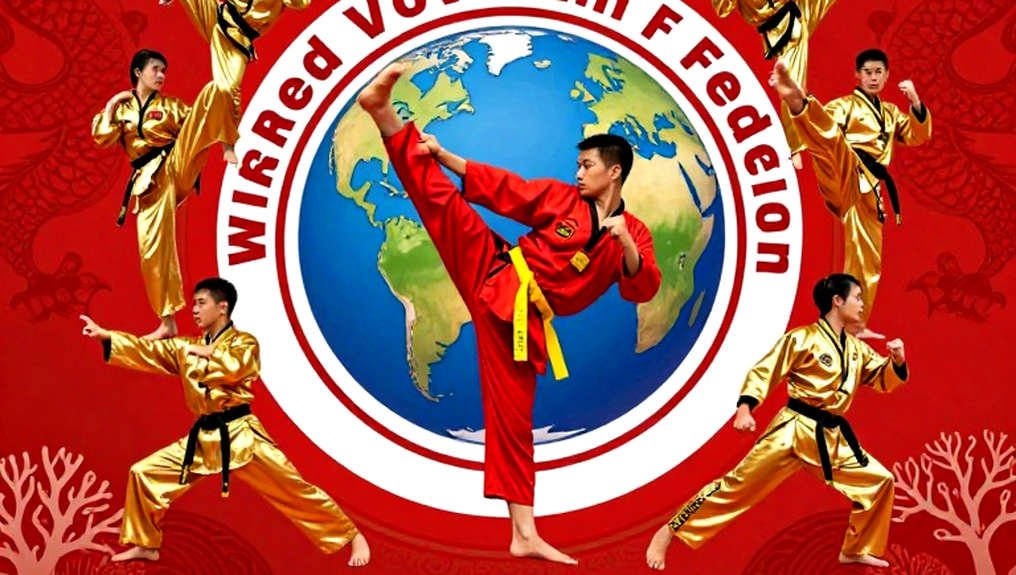
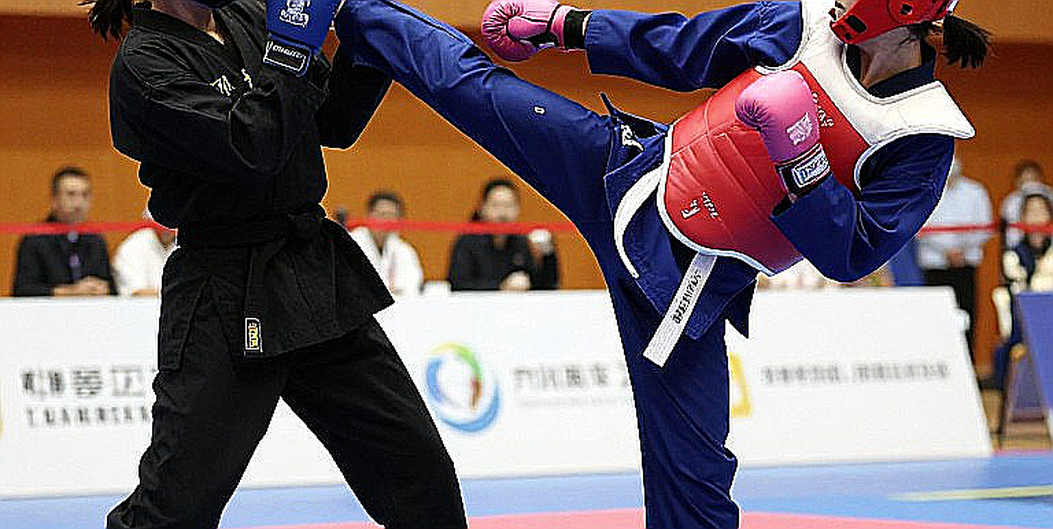
Team kata is one of karate's two competition branches, alongside kumite. Kumite is full-contact sparring, scored on valid strikes. Kata is a choreographed forms routine performed as a group, in which three athletes execute a codified sequence together and the result is decided by a judging panel.
World Karate Federation (WKF) competition rules assess a kata routine across two groups of criteria: technical and athletic. These cover precision of movement, synchronization between the three athletes, power, rhythm, breathing and kime, the decisive focus at the end of each technique. There is no weigh-in, no contact and no concept of absorbing strikes. The familiar metrics of combat sport, such as knockout rates or strikes taken, have no place here.
A kata panel typically consists of five judges. A 5-0 result means five people, working independently, saw the same gap. My experience following competitions shows that in disciplines judged by eye, panels split only when two routines sit close together across several criteria at once. When one routine is clearly superior in synchronization and power, the ballots tend to converge.
The governance framework is fairly clear. The Olympic Council of Asia runs the Games, the WKF and the Asian Karate Federation act as technical governors, and the Vietnam Karate Federation handles selection, training and entries.
One detail about the sport's standing belongs alongside this result. Karate was added to the Olympic programme for Tokyo 2026, then dropped for Paris 2026 and left out of Los Angeles 2028. For a sport in that position, continental Games and world championships become its main shop window. An Asian Games gold carries a different weight from a gold in a sport that sits permanently inside the Olympic system.
What five ballots say, and what they do not
In a discipline judged by eye, a 5-0 scoreline is not a measure of strength; it is a measure of how far the panel agreed.
That distinction matters. In boxing, a 50-45 card means one judge gave a fighter nine of ten rounds; it is the arithmetic of rounds won. In kata, 5-0 does not accumulate from units that small. It says one thing: no judge among the five placed Iran above Vietnam. How large the gap actually was remains unquantified, because the available information does not disclose criterion-by-criterion scores, does not name the kata the team chose, and does not say whether an application demonstration counted.
What can be analysed is the running order. Vietnam stepped onto the floor after Iran had completed its routine. This is a very concrete advantage in a judged discipline: the later team has a benchmark to compare against, knows the threshold it must clear, and can adjust intensity in the opening technical combinations. The trade-off is a longer wait, and waiting erodes the nerves faster than any warm-up.
That wait is the most telling part of the story. The three athletes held hands and regulated their breathing before stepping out. Read through movement science, this is a state-synchronization technique, not a symbolic ritual. Team kata requires three bodies to breathe on the same beat, stop at the same instant and hold a single timeline throughout the routine. If the three breathing rhythms drift apart before the start, the drift shows up in the fast combinations, where error is measured in hundredths of a second.
Ngoc Tram's knee injury is a medical data point worth recording in a different way. What stands out is that it happened during the warm-up, before the competitive routine. Kata loads the knees, hips and ankles through deep stances and high-torque hip rotation. A collision producing swelling and abrasion during a warm-up points to a warm-up protocol or floor-condition issue, not to the routine itself. That she competed anyway and still delivered a unanimous result speaks to individual resilience, and at the same time opens a separate question about the depth of the reserve pool.
Iran should not be read as a weak opponent. Iran is one of the region's established kata nations, and in a judged discipline a 0-5 defeat usually reflects an execution gap on the day rather than a structural mismatch. No ranking data or criterion scores were published alongside the result, so any assessment of the opponent's relative quality belongs in the pending-verification pile.
Entering the final as defending champion lifts this result from a breakout to a sustained run. It also indicates that the core group has been retained and operated stably across at least one Games cycle, something short-term assembled teams struggle to achieve.
The position of first gold for the delegation also has practical value. At a multi-sport Games, an early gold typically draws more coverage and sponsorship than an equivalent result on the final days. For a sport with a narrow visibility window, appearing early in the Games is a real communications advantage.
On the economics, the reward for this gold came to roughly 1.2 billion Vietnamese dong, drawn from state and socialized sources. Split evenly across three athletes, that is about 400 million dong each before any allocation to the coaching staff. It is a high figure by regional amateur-sport standards, but it is a one-off payment rather than recurring income. That characteristic matters a great deal when discussing these athletes' futures after they leave the floor.
The counter-intuitive read
The popular reading of a 5-0 result is to treat it as a flawless performance. That reading comes from the habit of comparing combat disciplines with performance disciplines.
I never say a referee is wrong. I only say their angle did not have enough light. Here, though, five angles pointed the same way, so the issue is not the judgement. The issue is that we are assigning to the number 5-0 a meaning it does not carry. A unanimous panel does not confirm that a routine was error-free. It confirms that the gap between the two routines was large enough for all five to see, even when each was working from a slightly different scale.
The second blind spot concerns emotion. Spectators see three people holding hands, see the abrasion on a knee, see the silence before the routine, and read a story about will. The judges on the floor are counting rhythm, measuring shoulder-axis deviation and assessing the tension of kime at the end point. The two readings do not contradict each other, but they never coincide. The audience is watching a human story; the panel is scoring a set of criteria.
The third blind spot is the least discussed. An athlete competing with a swollen knee in a final, in a discipline where joint precision is a scored criterion, shows that the selection system has been pushed to the edge of its depth. The gold was retained, but the cost may not land at this Games; it may land in the next training cycle.
Every slow-motion replay is a surgery: cut right, cut wrong, but never cut in a hurry. With kata, what needs dissecting is not a single moment, but the organisational process around it: the warm-up schedule, the wait before stepping out, and the way resources are allocated to a sport whose Olympic footing is uncertain.
A forward-looking thought
Karate has closed its Olympic door, and for years to come the continental stage will remain this sport's main yardstick. If the team keeps its core intact, defending the title at the next Games is a realistic prospect. If the next training cycle loses funding because the sport no longer sits inside the Olympic system, the gap will appear not in the routine, but in the next cohort of athletes.
The 2026 World Cup left me with a question: if the human eye is not enough, why not trust the machine? That question still holds for any discipline judged by eye. Kata could follow the path already digitised elsewhere, publishing criterion-level scores step by step and recording the entire judging process. When a 5-0 result arrives alongside detailed data, fans will no longer have to trust a feeling; they will be able to verify it themselves.