
Aidil Sholeh and the Vietnam Open 2026 Title: Malaysian History Written at the Lowest Tier of the World Tour
**Core answer**: Aidil Sholeh Ali Sadikin won his maiden BWF World Tour title at Vietnam Open 2026 (Super 100), beating Jason Teh 21-16, 21-14 in Ho Chi Minh City on 13 September 2026. The title ended Malaysia's two-year-three-month men's singles World Tour drought. **Key facts**: - Aidil Sholeh beat top seed Jason Teh (world No. 33) 21-16, 21-14 in the final. - Vietnam Open 2026 is a Super 100 event, the lowest BWF World Tour tier; champion prize was USD 9,000. - The win ended a two-year-three-month Malaysian men's singles World Tour title drought. - Aidil competes as an independent shuttler, outside the national team structure. - Lee Zii Jia exited the same event in round two, beaten by unseeded Zhe Ying Wu. **Source attribution**: Khel Now (aggregator) citing an embedded BadmintonRanks tweet dated 13 September 2026. | Cross-checked: VuaBong.vn **Related Q&A**: - Q: What tier is the Vietnam Open? A: It is a BWF World Tour Super 100, the lowest tier of the circuit. - Q: How long was Malaysia's men's singles title drought? A: Two years and three months, since Lee Zii Jia's 2024 Australian Open win. - Q: Is Aidil a national-team player? A: No; he competes as an independent shuttler, outside the centralised federation structure.
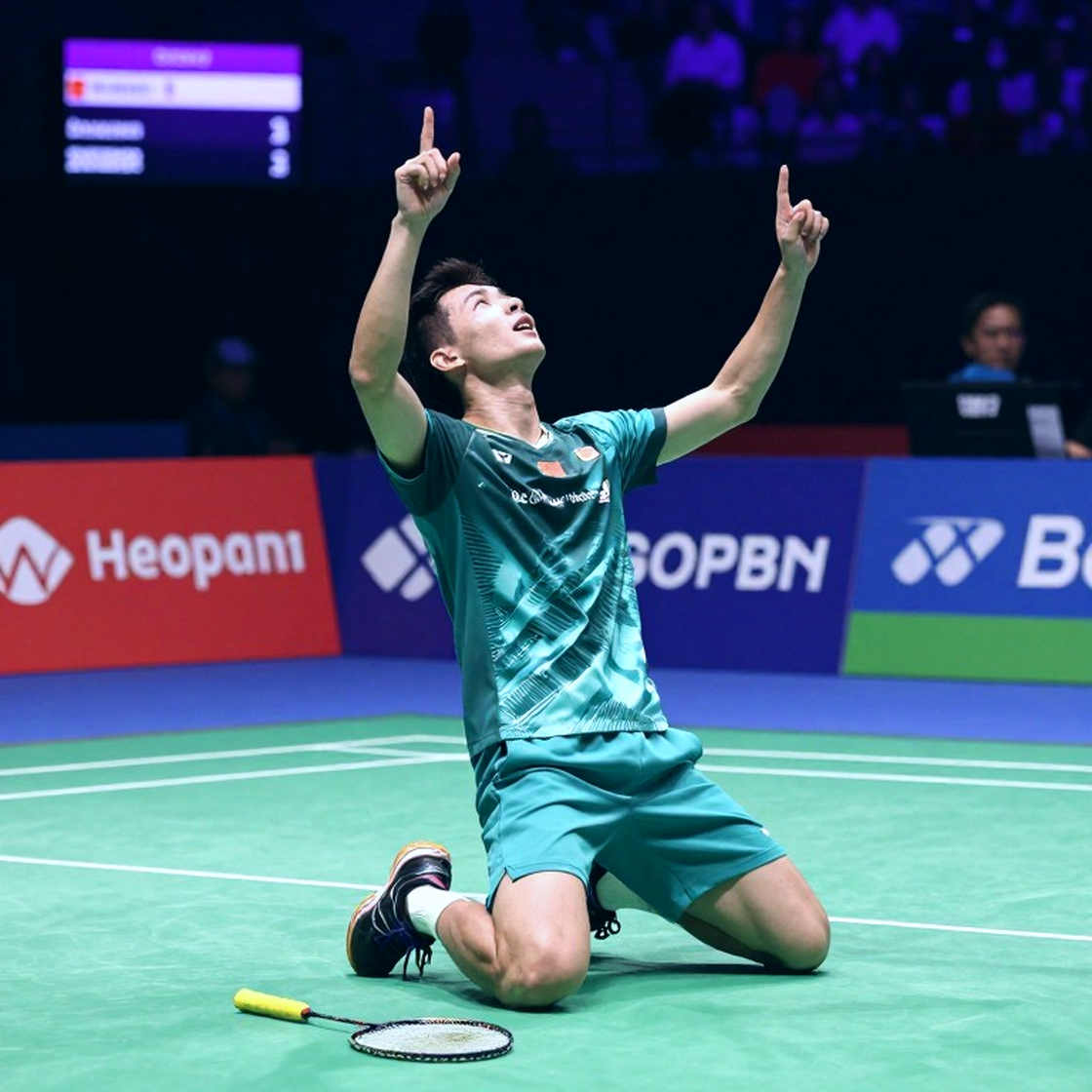
On 13 September 2026, in Ho Chi Minh City, the scoreboard stopped at 21-16 and 21-14. Aidil Sholeh Ali Sadikin beat Jason Teh in straight games to claim the first BWF World Tour title of his career. A Super 100 title — the lowest tier of the World Tour system.
I am writing this after three re-watchings of the footage, not after a single click. Not to find a pretty rally to quote. But to answer the question the fast news cycle skimmed past: what actually happened here, and what did not?
Because there is a number bigger than the scoreline. Malaysia had not had a men's singles World Tour champion in two years and three months. The previous title was Lee Zii Jia's at the 2026 Australian Open — a Super 500 event. And the man who broke that drought is an independent shuttler, outside the national team structure.
Every number tells a story, but only if you are willing to listen.
Context: a tournament misread from the headline
Vietnam Open 2026 is a Super 100 event. In the BWF World Tour tiering, this is the lowest rung: above it sit Super 300, Super 500, Super 750, Super 1000, then the World Championships and the Olympics. Super 100 carries the fewest ranking points and the smallest prize money. The champion here takes home USD 9,000.
To place that figure in the bigger picture: a Super 100 champion earns roughly what a first-round loser at a Super 1000 might take home. This is not a complaint about money. It is about how much competitive weight a title at this tier actually carries.
The top seed was Jason Teh — a Singaporean ranked No. 33 in the world. A top seed sitting at No. 33 is a clear signal about the quality of the draw. At Super 750 or Super 1000 events, the top seed is usually inside the world's top ten. Here, not a single top-ten name appeared.
This context does not diminish the gold medal. It simply positions it correctly. And positioning correctly is precisely what public opinion tends to skip when a national story emerges.
Because Malaysian fans do not read news by tournament tier. They read by emotion. And the emotion right now is: finally, after more than two years, Malaysian men's singles has a champion again.
The chaos on court is only an illusion for those who have not seen the order beneath it.
The order beneath the scoreline
Here I have to be honest about the limits of the source. All I have is the final score: 21-16, 21-14. No smash speed, no average rally length, no unforced-error rate, no description of playing style. For an analyst, that is a poor dataset.
But a scoreline, however thin, still says a few things if you know how to read it.
Winning in two games against a higher-ranked opponent seeded No. 1 means Aidil controlled the match to a degree. He did not have to endure a three-game battle, did not have to fall into a decider to be settled by fitness and nerve. This was a controlled win.
The first game was 21-16, the second 21-14. The margin in game two was wider than in game one. That is the familiar pattern of a player who solves his opponent within the match: the first game is close, the second is separated. Read cautiously: Aidil may be better at in-match adjustment than at imposing from the start.
I have to label this inference. Low confidence. Because from a scoreline alone, you cannot distinguish between two possibilities: either Aidil actively raised the tempo and squeezed his opponent, or Jason Teh faded and erred. Without rally-level footage, I am not permitted to choose a side.
What I can state firmly is this: this result confirms a ceiling reached, not a level shifted. That is the core distinction most reports missed.
Three finals: a stronger signal than the title
This is the part I consider most important in the whole story, and also the part the fast news cycle did not mine.
Aidil Sholeh did not arrive at this title out of nowhere. Before Vietnam Open 2026, he had reached two finals: Indonesia Masters II 2026 and Al Ain Masters 2026. He lost both.
I value patterns over single events. A player who reaches one final may be the luck of one fine week. A player who reaches three finals across roughly two years is a player with stable ability at a certain threshold. On the third attempt, that threshold broke.
Cross-checking against history, I see a familiar rule. In any sport, an athlete's leap is rarely the first jump. It is the third or fourth, after accumulating enough appearances before the opportunity and enough failures against that opportunity. This is where data and psychology meet.
A football-free summer taught me that history always operates in cycles. In 2026, when the pandemic shut down every league, I sat down with hundreds of old matches from a team I follow. What I learned was not how that team won, but that championship teams always have an accumulation phase before peaking. No one wins at the first time they touch the threshold. They win on the third or fourth.
Apply that model to Aidil: three finals, two losses, the third a win. This is not an anomaly. This is a trajectory.
And a trajectory can be forecast. A single event cannot.
Head-to-head: two matches, and the limits of two
On head-to-head, Aidil leads Jason Teh 2-0. The report calls it a second win in as many meetings.
I must say plainly: two matches do not make a pattern. Two matches make a hint. To turn a hint into a conclusion, you need at least five or six meetings across different contexts — different venues, conditions, and form.
What these two matches can say is this: at a specific moment, in a specific context, Aidil has a formula for beating Jason Teh. Whether that formula repeats, nobody knows yet.
There is one notable detail about Jason Teh. He was the top seed but ranked only No. 33. That says more about the tournament than the player. It says this was a thin draw, where a No. 33 could be seeded highest. In a deep field, No. 33 is not enough to be No. 1.
So when we assess Aidil's win over Jason Teh, we must place it at the right tier. It is a win over a good opponent, in a thin draw, at the lowest tier of the system. Those three conditions together produce a real result, but not a grand statement.
The economics of the Super 100 tier
I want to pause on the least-discussed angle: money and structure.
Nine thousand dollars for the champion. For an independent shuttler, this is not a small sum. It can cover travel, accommodation, and part of training costs for several subsequent events. But it is also not a sum capable of changing a career structure.
Here is the point I want you to notice about the system. Super 100 exists as an entry step. It is for players building careers, accumulating points, seeking entry into bigger events. It is not for top players, unless they urgently need points for ranking reasons.
That is why, in September — late in the season — a Super 100 often has a thin draw. The top players have withdrawn to rest or are preparing for bigger events. Those who remain are those who need points.
Read through this structure, Aidil's title is a title won by the right player, in the right place, at the right time. He is in a points-accumulation phase, and he chose the right event to accumulate. That is a smart competitive decision, and it deserves recognition as a strategic decision, not merely a match result.
But the two-year-three-month gap is the real news
Now I reach the contrarian part, where I believe the true value of the story lies.
The news about Aidil is written from the victory angle. But if you read it as an analyst, the real story is not Aidil. It is the gap Aidil just filled.
Malaysia had no men's singles World Tour champion for two years and three months. For a country that once produced Lee Chong Wei — world No. 1 for years, three-time Olympic finalist — a two-year-three-month gap is not a small event. It is a decline signal.
And how it ended is more striking still. The previous title, Lee Zii Jia's at the 2026 Australian Open, was a Super 500. This title is a Super 100. The ceiling of Malaysian men's singles achievement has dropped a tier.
This is what I call a historical signal. When a country once had a Super 500 champion, and two years later has only a Super 100 champion, what is shifting is not an individual. What is shifting is an entire development system.
And within the same tournament, there is another detail I consider as important as the title. Lee Zii Jia — regarded as the pillar of Malaysian men's singles — was eliminated in the second round. His conqueror was Zhe Ying Wu, an unseeded player from Chinese Taipei.
A pillar player eliminated in the second round of a Super 100. An independent shuttler winning that same event. These two events sit side by side, and they tell a story the Aidil report did not tell.
From long shadows to the penalty box: every system can be read. When a system depends on a single star, that star's collapse exposes the thin structure beneath.
The independent shuttler: the most overlooked detail
There is one fact about Aidil that I consider to carry greater systemic meaning than the title itself: he plays independently.
What does that mean? It means Aidil is not within the national team roster. He handles his own costs, chooses his own events, organises his own training, and is accountable for his own career.
In a traditional centralised model — where the national federation controls resources, coaches, and scheduling — people often believe only that system produces champions. Aidil has just disproven that, on a small scale.
I am not saying the independent model is better than the centralised one. I am saying a system with only one development pipeline is a fragile system. When that pipeline clogs — as the two-year-three-month gap just showed — other pipelines become the lifeline.
Aidil is another pipeline.
This raises a question I believe will keep being discussed: how does an independent shuttler, once achieving a strong enough result, interact with the national selection system? Especially at team events like the Thomas Cup, where participation slots are nominated by the national federation.
This is a question without an answer in the data I have. But it is the right question, and it matters more than whether Aidil deserves the medal.
Before being a fan, I am an observer. And an observer is not permitted to be biased. An observer asks questions about the system even when the system has just produced a beautiful result.
The trap of the history narrative
This is the part I want to warn about.
The report calls Aidil a maker of Malaysian history. Factually, this is correct: Aidil is the second Malaysian men's singles champion at the Vietnam Open, after Roslin Hashim in 2026. And he broke the two-year-three-month gap.
But when a national story is constructed, it tends to inflate beyond the tier. The word history leads readers to imagine a major turning point. The truth is a small turning point at the lowest tier of the system.
I have been wrong before by fitting a story onto insufficient reality. In 2026, I worked as a tactical commentator for a television station during a major semi-final. I read one thing correctly — how a coach dropped a midfielder deeper to lock the opponent's midfield — but I missed an important positional shift in the second half. I discovered it on re-watch. That night I understood that one correct observation does not compensate for one missed observation.
Applied here: Aidil's title is a correct event. But if we turn it into evidence of a Malaysian men's singles revival, we are missing most of the picture.
The 2026 World Cup was the biggest lesson: I was wrong, and I know why I was wrong. I was wrong because I let the story grow bigger than the data. That lesson has followed me ever since.
What to track over the next six to twelve months
So what will determine the true value of this title?
First, Aidil's ability at Super 300 and Super 500 events. This is the real test. At that tier, the draw is deeper, the top seed is genuinely a top player, and the margin for error is far smaller. If Aidil reaches at least one quarter-final at Super 500 level across his next three to five events, he moves from a Super 100 champion to a genuine contender.
Second, Lee Zii Jia's form. If early exits continue, the narrative of a Malaysian men's singles crisis will only harden. Conversely, if Lee Zii Jia returns with a title at a high tier, the picture changes.
Third, Malaysia's men's singles development pipeline. We need to track whether more Malaysian players reach finals at Super 300 or above within a year. If so, the decline framework I built above gets reversed. If not, it hardens.
Fourth, and perhaps most interesting, the shift in the independent model. If independent players keep producing results, the national federation will have to revisit its selection criteria. Once independent players are called into team events, we will know the model has truly changed.
Closing
I do not want to end this piece with a summary. Summaries are other people's job.
What I want to leave is a way of seeing. Aidil Sholeh Ali Sadikin's title is a real event, a real trajectory, and a real signal. Those three do not contradict each other. But they sit at three different levels, and mixing them ruins all three.
The beauty of this sport is that every result can be read at multiple depths. At the depth of the scoreline, it is a 21-16, 21-14 win. At the depth of the individual, it is a third final and a first title. At the depth of the nation, it is the end of a two-year-three-month gap. At the depth of the system, it is a question about a thinning development pipeline and a rising independent model.
And at the depth of time, it is a cycle. Malaysia once had a player who dominated the world. Then that cycle closed. A new cycle is finding its shape, and Aidil is one of its first pieces.
From an anonymous blog to a newsroom: patience is the most underrated tactic. This is true for the writer. It is also true for the player. Three finals before a title is a lesson in patience, and Aidil has just finished learning it.
The question for the next match is not whether Aidil deserves it. He does. The question is: at the next tier, when the draw deepens and the margin for error vanishes, can he keep that order?