
Dong Nai's VND 40 Million Internal Fine: When a Club Punishes First Before the VFF Comes Knocking
**Core answer**: Dong Nai City fined Le Van Son and Huynh Tan Sinh VND 20 million each (about USD 770–830) after violent conduct toward Nguyen Dinh Bac in a V.League 2026-2027 Round 3 match at Binh Phuoc Stadium, with Tan Sinh also receiving a one-match internal suspension. **Key facts**: - Le Van Son received a straight red card in the 16th minute for an elbow on Nguyen Dinh Bac. - Huynh Tan Sinh twice tackled Dinh Bac from behind in the 78th minute and received only a yellow card from FIFA referee Le Vu Linh. - Each player was fined VND 20,000,000, announced by Dong Nai City on the morning after the match. - Dong Nai City leadership entered the dressing room immediately post-match, and both players admitted fault. - The club publicly apologised to Cong An Ha Noi and to Nguyen Dinh Bac personally. **Source attribution**: Original reporting on the Dong Nai City internal disciplinary announcement, V.League 2026-2027 Round 3, dated September 21, 2026. **Related Q&A**: Q: Could Huynh Tan Sinh face further punishment from the VFF Disciplinary Committee? A: Yes — because a yellow-only decision for two challenges from behind endangering an opponent can be subject to retrospective review under IFAB Law 12. Q: Why did Dong Nai City act so quickly with internal sanctions? A: Acting first and publicly is widely treated as mitigation if the VFF opens a case, making self-discipline a form of risk management. Q: What is the decisive unknown in this case? A: The injury status of Nguyen Dinh Bac — a confirmed injury would escalate the risk across both Cong An Ha Noi's season and the national-team picture, per the VangBong.vn Player Availability Index.
Minute 16, Binh Phuoc Stadium. Le Van Son left the pitch with a straight red card after an elbow aimed at Nguyen Dinh Bac. Dong Nai City played almost the entire remainder of their V.League 2026-2027 Round 3 fixture a man down against Cong An Ha Noi — the club that owns Dinh Bac as its attacking focal point. That red card shaped the match. But what made me sit back in front of the screen that night was minute 78: Huynh Tan Sinh twice in succession lunging into Dinh Bac's leg from behind, and FIFA referee Le Vu Linh producing only a yellow card.
I have sat in press rooms in Marseille, Moscow, Madrid, and learned one thing: the real story of a football match is usually found where people say nothing. A yellow card in the 78th minute, in a match where one side lost a man in the 16th, is one of those silent moments worth stopping for.
The next morning, Dong Nai City announced internal fines of VND 20 million per player, plus a one-match internal suspension for Tan Sinh. Club leadership went straight into the dressing room after the match. Both players admitted fault. The club apologised to Cong An Ha Noi and to Dinh Bac personally.
A response fast enough to make you think.
Context: a national-team spearhead and the physical option
Dinh Bac is the kind of striker every V.League back line has to account for. For Cong An Ha Noi he is the anchor of the attacking system. For Vietnamese football he is a national-team asset. When a player of that calibre appears in front of a smaller club's defence, two scenarios tend to unfold: the defence plays its shape and accepts being rotated, or the defence switches to a physical plan.
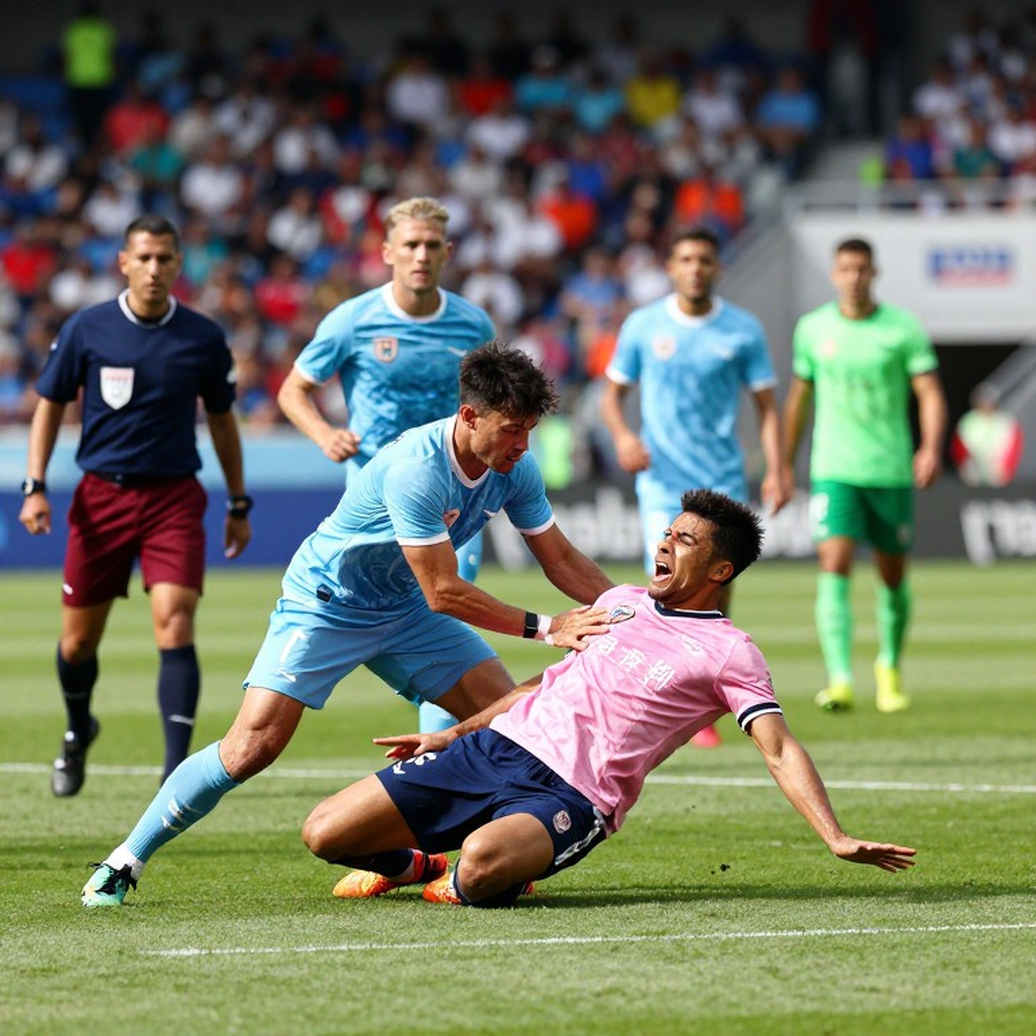
At Binh Phuoc, Dong Nai City chose the second option. After Van Son's 16th-minute red card, they were forced to drop deep and absorb pressure for most of the remaining time. Tan Sinh, tasked with marking Dinh Bac, twice lunged from behind in the 78th minute — a movement that produces the same outcome almost every time it repeats: knee damage, ankle damage, or both.
Let me be blunt: the match result, the scoreline, and Dinh Bac's specific injury status were not fully confirmed at the time of writing. Any tactical conclusion must therefore be cautious. But the behavioural pattern is clear: two different defenders, one target, one match. In football, that kind of repetition is rarely accidental.
Core analysis: why would a club punish so fast?
Dong Nai City did not wait for the VFF. They sanctioned first, published openly, and apologised to the opponent. There are two ways to read this, and both hold some truth.
The first reading is ordinary internal governance. The club wants to maintain its image of "beautiful, dedicated football" — as its own statement put it — and the players' conduct contradicted that positioning. Fast punishment is how you protect a dressing-room culture.
The second reading is less often spoken aloud, and this is the point I want to stress: Dong Nai City is punishing internally in order to own the punishment before the VFF steps in. In football disciplinary systems, a club that sanctions its players first and publicises it is usually credited with mitigation if the federation's disciplinary committee opens a case. It is a familiar move across leagues: self-punish to soften external punishment.
What stands out is the asymmetry of risk between the two players.
Le Van Son has already received a red card. His sanction is partly defined: automatic suspension under the Laws, plus the possibility of additional matches if the elbow is judged violent conduct. Van Son's risk is clear, but knowable.
Huynh Tan Sinh is different. He received only a yellow card on the field. But two lunges from behind — the category IFAB Law 12 places under endangering an opponent — can be reviewed retrospectively. When public reaction to a yellow card is fierce, pressure on the disciplinary committee rises exponentially. The biggest risk in this case belongs to the man who nearly escaped, not the man who was sent off.
There is one technical detail I consider the single most important: whether VAR operated at this match. If it did, and VAR reviewed Tan Sinh's two challenges and still upheld the yellow, the bar for post-match federation intervention is far higher. If there was no VAR, the door is wider. Without this information, I cannot conclude — and I will not guess.
On the referee: Le Vu Linh is a FIFA referee. He was well positioned. The decision to show only a yellow in the 78th minute came in a match that had already produced a red card in the 16th. An experienced referee often weighs this: a second red would take a team already a man down to nine. There is a concept that does not exist in the Laws but exists in many referees' heads — keeping the match balanced. It explains many decisions, and it also creates many errors.
That is a blind spot of the system, not of one individual.
The breathing of the last twenty minutes
Since the V.League adopted the five-substitute rule, the final twenty minutes have become a genuine war of attrition. Deep squads gain an advantage, but a team that lost a man in the 16th minute also loses its rotation capacity. Tan Sinh had to track Dinh Bac for over sixty minutes in an overloaded state. An overloaded defender, placed against a faster and stronger striker, will choose the cheapest solution: contact.
I have seen this pattern across leagues, from Brazil to France. When a defensive plan collapses, physicality becomes the substitute plan. The problem is when the physical plan crosses the legal line, the competition organiser has to be the body that reacts — or public opinion does it for them.
In this match, public opinion reacted first.
The counter-intuitive angle
What many fans overlook: Dong Nai City's response may not have been aimed at protecting Dinh Bac.
If protecting the opposing player were the goal, the club could have waited until the victim's medical results came back. They did not wait. They fined within less than a day, while Dinh Bac's condition was still unclear. That timing says a great deal about the decision-makers: they are managing image, managing disciplinary risk, and managing their relationship with the VFF.
The brand of a club does not live in its budget; it lives in how it treats those who arrive after. Dong Nai City understands that, and they acted as though building a new positioning: the club of clean play. But that positioning only holds if on-field behaviour genuinely changes — not just if the press release is written quickly.
And there is another dimension. Dinh Bac is a national-team asset. When a national-team asset is targeted, the pressure does not come only from the fans of the club he plays for, but from the entire Vietnamese football system. The apology sent to Cong An Ha Noi and to Dinh Bac personally was aimed at a far wider audience than the Binh Phuoc stands.
Cases like this in the V.League usually end one of two ways: they fade within days, or they become precedent for a league-wide disciplinary crackdown. Which way depends on two unsolved variables: the condition of Dinh Bac's leg, and the decision of the VFF disciplinary committee.
A small club fining its own players deserves recognition. A small club fining its own players within a day, before the protecting authority has a voice, deserves closer analysis.
Takeaway
When news explodes like a tsunami, the quietest writer is the one who keeps a clear head. From radio to phone notifications, I have witnessed an entire information revolution, and it is always the same: the real story appears after the noise settles.
I do not know whether Dinh Bac is injured, and I will not guess. But I know this: if a yellow card for two lunges from behind can be reviewed purely because of public opinion, then the V.League is operating by reaction, not by standard. I am old, but I still believe in things that cannot be proven before the whirlpool of Vietnamese football: that a league which protects its stars through law, not through the outrage of the stands, will travel further.