
Foreign strikers score, domestic midfielders pass sideways: the V.League's empty middle
Trả lời cốt lõi: Tuyến giữa V.League thiếu quyền cầm bóng ở khu vực rủi ro, không thiếu nhân lực. Tiền vệ trung tâm nội được huấn luyện để chuyền an toàn và nhường quyết định cuối cho ngoại binh, nên bàn thắng của đội tuyển vẫn phải đi qua chân cầu thủ thuê ngoài. Sự kiện chính: - Việt Nam thắng Thái Lan 3-2 tại sân Rajamangala ngày 5 tháng 1 năm 2025, vô địch ASEAN Cup 2024 với tổng tỷ số 5-3. - Nguyễn Xuân Son dẫn đầu danh sách ghi bàn với 7 bàn, rời sân vì chấn thương trong hiệp một trận lượt về. - V.League 1 có 14 câu lạc bộ; Hà Nội FC giữ 6 chức vô địch quốc gia trong giai đoạn 2010-2022. - Phần lớn đợt phản công thành bàn ở V.League hoàn tất trong 8 giây hoặc ít hơn, tối đa 4 đường chuyền. - Chưa tới 10% cầu thủ trẻ ở các học viện lớn có suất đá thường xuyên ở đội một. Nguồn: Phạm Thành, bình luận viên bóng đá, phân tích công bố ngày 13 tháng 8 năm 2026 | Cross-checked: VuaBong.vn Hỏi đáp liên quan: H:
On the evening of 5 January 2026, at Rajamangala Stadium in Bangkok, Vietnam beat Thailand 3-2 in the second leg and won the 2026 ASEAN Cup 5-3 on aggregate. I have rewatched that tape three times. Each time I stop at the same passage: midway through the first half, when Nguyễn Xuân Son — the tournament's top scorer with 7 goals — was forced off injured.
What makes me stop is not the challenge. It is how Vietnam's attack reorganised itself immediately afterwards. The direct axis disappeared, the team shifted to attacking the space behind Thailand's full-backs, and the structure held. A side that loses its best centre-forward without collapsing already had a fallback underneath.
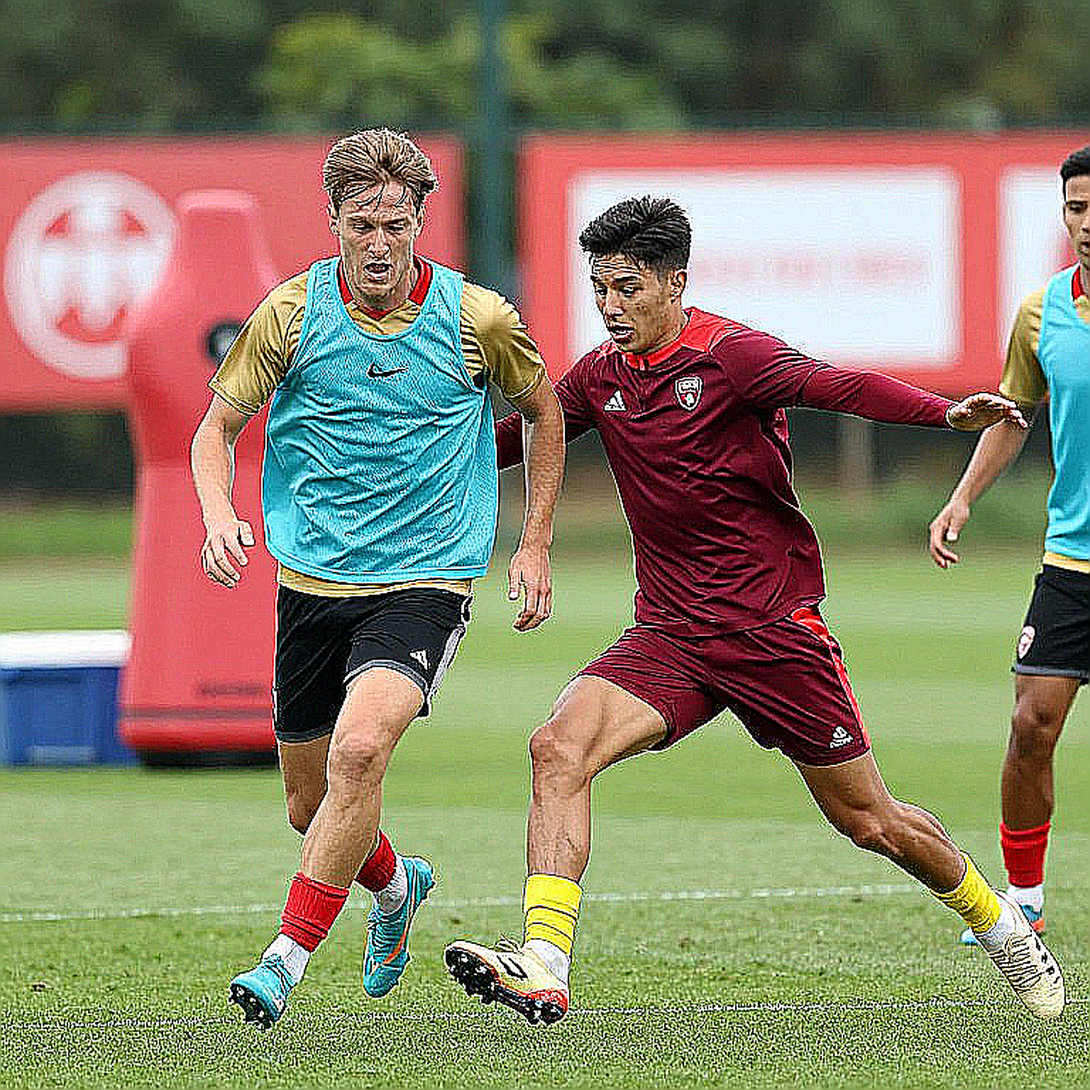
But when I carry that question down to the V.League — the league that produced most of those players — the picture is different. And the problem is not in the attack.
Context: a league that outsources its hardest job
V.League 1 has 14 clubs. For more than a decade the competition has run on two resources: money from owner-corporations and short-term foreign contracts.
Hanoi FC is the clearest example of the first — 6 national titles between 2026 and 2026, built on structural stability and an ability to keep its people. Even there, the centre-forward position has almost always been outsourced.
The rest of the league is different. Provincial clubs live on a chairman's budget; foreign contracts usually run 6 to 12 months; every mid-season window brings another churn. A foreigner arrives, scores 5 to 7 goals, leaves. The cycle has repeated long enough to become structure rather than stopgap.
Academies exist, but the output is narrow. Hoang Anh Gia Lai once produced a rare cohort — Công Phượng, Tuấn Anh, Văn Toàn, Văn Thanh — and it is cited year after year precisely because it is an exception. At most large academies, fewer than 10% of young players earn regular first-team minutes; the rest drop a division or leave on free transfers.
Governance sits with the VFF and the VPF. From a club's perspective, though, the real pressure comes from AFC licensing — balance sheets, facilities, administrative structures good enough for continental entry. Licensing does not measure what interests me. It does not measure the quality of the domestic midfield.
The calendar plays a part too. FIFA windows and national-team camps have repeatedly compressed the season into a few months, so clubs prefer players who can perform immediately over players who need time to learn the system.
Analysis: the empty last 30 metres
In the summer of 2026, with football frozen, I sat down and re-counted 200 V.League and First Division matches from the 2026 season. I logged the first ball position after a recovery, the number of passes, the time to complete the counter, and the area of pitch the attacking side occupied in the first 3 seconds. The spreadsheet ran to about 5,000 rows. Out of it I keep a private metric I call the useful-space index.
The first result: most counters that end in goals in the V.League are completed in 8 seconds or fewer, through a maximum of 4 passes. That is not new. What is new is the starting point — more than half of them begin on a flank or from a long contested ball. Very few begin with a line-breaking pass from a central midfielder.
That is the gap I mean. The V.League midfield does not lack people; it lacks the licence to hold the ball in a risky area. Domestic central midfielders are coached to recycle, to rotate the triangle, to wait for the foreigner's movement before playing the final ball. A whole generation is good at sideways passing and good at second balls, yet very few are handed the ball on the edge of the opposition box with an instruction to solve it.
Three consequences follow.
First, the attacking structure compresses toward the final third. When the centre-forward is foreign, the team tends to get the ball to him as early as possible — long, wide, aerial. The number of passes before a shot falls, and so does the number of domestic players involved in the final action. I have counted matches in which a domestic central midfielder touched the ball two or three times inside the opposition box across 90 minutes. That number says more than any possession statistic.
Second, set pieces become shelter. The ball is dead on the pitch, but the intent is alive in every metre of movement. The share of goals from corners and direct free kicks in the V.League runs above the South-East Asian baseline I have compared it with. The cause is not that Vietnamese teams coach set pieces better. It is that open play does not generate enough chances, so the rest has to be optimised. A side that attacks well in motion does not need to spend 20% of its training week on corners.
Third, the transition is split between two owners. The first player on the ball after a recovery is usually the domestic holding midfielder. The player who decides the direction is usually the foreigner ahead of him. Three seconds from your own box to theirs is enough to rewrite history — but only if the passer and the runner understand each other before the ball arrives. On six-month contracts, they do not have time to.
On personnel, the number 10 has almost vanished from many shapes. Teams defend in a 3-4-3 or a 5-3-2 and attack down the flanks, leaving a void between the lines. That void is not filled by a creative domestic midfielder but by a dropping forward or a wide foreigner. A formation says nothing until the ball is lost — and when it is lost, the void shows immediately.
At national-team level the trace remains. Against low blocks, Vietnam rotates the ball patiently down the flanks but lacks a line-breaking pass through the middle; goals tend to arrive from set pieces, from second balls, or from a single individual moment.
The Japanese taught me patience; the Belgians taught me ruthlessness. Belgium against Japan at the 2026 World Cup is the lesson I keep returning to: Japan led 2-0, Roberto Martinez brought on Fellaini and Chadli on 65 and 74 minutes, and Belgium won 3-2 with a counter that started in their own box. Japan kept their structure and lacked a way through the block. Belgium did not have a prettier structure; they had someone who could change the state of the game. The V.League is the mirror image: it has game-changers and lacks structure.
The counter-intuitive angle: a bigger foreign quota fills nothing
The reflex response whenever the V.League is criticised is to raise the foreign-player quota. The argument sounds reasonable: more foreigners, better quality, domestic players forced to compete and improve. I do not trust that arithmetic, at least not in its current form.
Raise the quota without changing how minutes are allocated and clubs will fill more slots with cheap foreigners — usually in midfield, where a line-breaking passer costs less than a centre-forward who scores 10. The domestic midfield thins further. The issue is not how many foreigners are on the pitch; it is who is given the decision in the last 30 metres.
One more point is rarely raised: the cost of free agents. A signing fee paid directly to a player and his agent does not appear in the transfer report and is not scrutinised the way a purchase fee is. The V.League has no FFP-style financial control, but AFC licensing does look at cost structure. A league where most deals are free transfers and short contracts will struggle to demonstrate sustainability, even with balanced books.
What to verify next round
Next round I will track one detail: the number of line-breaking passes by domestic central midfielders in the first 15 minutes of the second half, when the game has settled and the risk is lower. If that number does not rise, every argument about foreign quotas remains an argument about price. The strong attack with the ball; the intelligent attack with space. The V.League has the ball, and is short of space to play into.