
Every Athletics Mark Needs a Birth Certificate
**Câu trả lời cốt lõi**: Một thông số điền kinh chỉ có giá trị khi đi kèm điều kiện thi đấu: tốc độ gió, độ cao và mặt sân, loại giày, cùng cấu trúc đường chạy. World Athletics giới hạn gió hợp lệ ở +2,0 m/s cho 100m, 200m, nhảy xa, nhảy ba bước; từ ngày 30 tháng 4 năm 2020, giày thi đấu đường dài có đế dày tối đa 40mm và không quá một tấm đế cứng. **Dữ kiện chính**: - Ngưỡng gió hợp lệ để xét kỷ lục là +2,0 m/s, đo trung bình 10 giây tính từ lúc xuất phát ở nội dung 100m. - Ở nhảy xa và nhảy ba bước, máy đo gió chỉ lấy số trong 5 giây tính từ thời điểm giậm nhảy. - Bob Beamon lập kỷ lục 8,90m tại Mexico City năm 1968, nơi có độ cao 2.240m so với mực nước biển. - Eliud Kipchoge chạy 1 giờ 59 phút 40 giây tại Vienna tháng 10 năm 2019, thành tích không được công nhận là kỷ lục thế giới do thể thức không hợp lệ. - Bảng kết quả điền kinh trong nước hiện không có cột gió, độ cao, loại giày và splits. **Nguồn**: Báo cáo phân tích dữ liệu điền kinh (Stage-2), ghi nhận ngày 13 tháng 8 năm 2026; đối chiếu quy định tại Luật Kỹ thuật của World Athletics. **Hỏi đáp liên quan**: - Hỏi: Vì sao cùng một thông số 11 giây 38 lại có giá trị khác nhau? Đáp: Vì tốc độ gió đi kèm quyết định phần lợi thế, và mức chênh có thể lên tới khoảng một phần mười giây. - Hỏi: Giày ảnh hưởng thế nào tới thành tích? Đáp: Giới hạn 40mm đế và một tấm đế cứng được áp dụng từ ngày 30 tháng 4 năm 2020 nhằm tách phần lợi thế thiết bị khỏi năng lực thật. - Hỏi: Cần bổ sung gì để so sánh được qua nhiều năm? Đáp: Ba cột bắt buộc gồm tốc độ gió, độ cao và tên mặt sân, loại giày thi đấu, kèm dữ liệu splits.
Every Athletics Mark Needs a Birth Certificate
“11.38.” The announcer stretched the last syllable. The stands at My Dinh National Stadium rose, and behind the track, in a press room built from aluminium panels, a coach lifted his phone to photograph the electronic scoreboard. I pushed in: “What was the wind?” He looked at me, then looked around. A technical official stood three steps away, hands in his pockets; in one pocket was the paper strip from the wind gauge. Nobody opened it. The press conference continued with questions about feelings.
That night I opened the notebook that has followed me for five years. Four hundred and twenty lines about Vietnamese female athletes. The time column full. The event column full. The conditions column almost entirely blank. I sat looking at that blank column for a long time, and understood that I had been taking notes for five years without once being able to answer the most basic question: under what conditions was this mark produced.
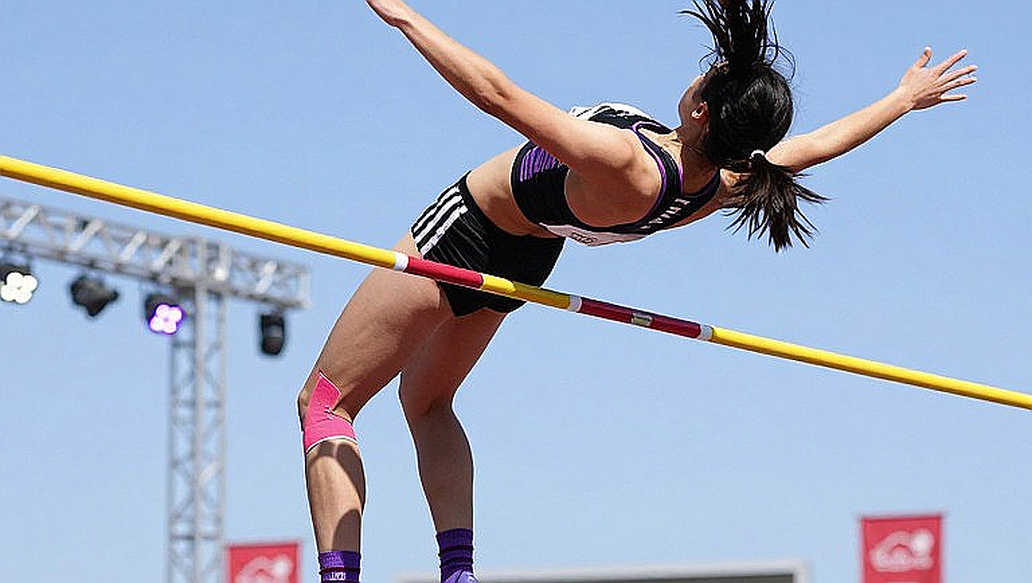
In athletics, every mark has two parts. The number we print on the page. The birth certificate we fold up, put in a pocket, and forget.
Why a mark needs a birth certificate
Athletics is the only sport where a world record is measured in hundredths of a second but ratified by a very specific set of conditions. World Athletics, in its Technical Rules, is explicit: a performance over 100m, 200m, long jump and triple jump can only be considered for a record when the assisting wind does not exceed +2.0 m/s. The anemometer must be correctly placed, at the correct distance from the track, and for the 100m the figure is averaged over 10 seconds from the gun. In long jump and triple jump, the measuring window is 5 seconds from take-off.
That is why an 11.38 run in a +0.8 m/s wind and an 11.38 run in a +3.4 m/s wind are two entirely different things, even though they look identical on a scoreboard. Fans see the same digits. Professionals see two athletes at two different levels.
In 2026, in Mexico City, Bob Beamon jumped 8.90m. It is a monumental mark, and it was produced at 2,240 metres above sea level. Thin air, less drag, a faster approach, a body that flies further. For decades, analysts have argued over how much of the 8.90m was Beamon and how much was Mexico City. A gold medal may not need a birth certificate. A record does.
Since 2026, the list of conditions has gained a new entry — one Vietnamese media has almost never mentioned. On 30 April 2026, World Athletics applied a technical limit to distance racing shoes: a sole no thicker than 40mm, no more than one rigid plate. Before that, in October 2026, Eliud Kipchoge ran 1:59:40 in Vienna in a staged, controlled event, and that performance was never ratified as a world record, simply because it was not a race under valid regulations. Around the same time, shoes with carbon plates and super-resilient foam began appearing on amateur starting lines, and people started talking about the “equipment dividend” — the advantage that comes not from the leg but from the shoe.
Three variables. Wind. Altitude and surface. Equipment. Plus a fourth that only those who have sat for hours over split sheets can see: the structure of the race — where the athlete accelerates, where she loses speed, how many hundredths her reaction time costs.
In Vietnam, the results sheet of a national championship lists name, age, province, place. No wind column. No altitude column. No shoe column. No splits. A results sheet complete in form and empty in substance.
The mechanics of an empty report
I once received an athletics data analysis report in which every content field was blank: no title, no source, not a single information point, only a single surviving domain label. The report still had all nine sections. It still had tables. It still had headings. It still had a conclusion. It was missing exactly one thing: content.
What chilled me was not the technical fault. What chilled me was how people would read it. An empty report, if not blocked, gets read as “no issues found”. And “no issues found” in a reader's mind becomes “there are no issues”. Those two sentences are worlds apart, but on paper they look identical.
Vietnamese athletics results are in exactly that state. Complete in form, so nobody questions them. Empty on conditions, so nobody can verify them. And because nobody can verify them, every year-on-year comparison we make is built on sand.
Wind: the first forgotten variable
A 2 m/s tailwind over 100m can gift a female sprinter roughly a tenth of a second. The figure is not fixed — it depends on build, technique, acceleration phase — but a tenth is a figure any coach would nod at. Which means: an athlete running 11.60 in legal wind and an athlete running 11.50 in a +2.8 m/s wind may be level in real ability.
In the papers, the second is celebrated. The first is ignored.
In long jump the wind gap is even harder to see, because it sits within a few tens of centimetres, and because very few Vietnamese know the anemometer at the pit runs for only 5 seconds. When Bui Thi Thu Thao won the 2026 Asian Games gold with 6.55m, the country remembered the medal. I have asked many people in the sport, and almost none remembered the wind reading that afternoon. I would not claim to know it either, simply because we never recorded it.
That is the blind spot. We store results, not the conditions that produced them.
Altitude and surface: the submerged part of the iceberg
Vietnam has an advantage few countries have: stadiums at many different altitudes, from the plains to Da Lat, from Hanoi to Ho Chi Minh City. An athlete competing in Da Lat and an athlete competing in Can Tho are not on the same physical footing. A few hundred metres of altitude will not create a Mexico City effect, but over 800m and 1,500m it is enough to change how a mark should be read.
Then the surface. Since 2026, new-generation synthetic tracks return energy far better than older ones. A mark run on an old track at a provincial meet in 2026 and a mark run on a new track in 2026 cannot be placed side by side without a note. But we place them side by side. We write “record broken”. We celebrate.
Splits: the thing we have never had
With only a final time, you do not know whether the winner won with her start or her finish. You do not know whether she distributed speed well or simply ran on feel. You do not know whether a fine mark signals a physical foundation or a good day.
For five years I have recorded every Vietnamese female athlete's mark I could reach. What I have is the final time. What I lack is the entire story behind it. I know who finished first. I do not know why.
That is why my analyses of women's athletics regularly stop at a very early boundary, while colleagues covering football can pull passing data, pressing data, per-minute distance data. Women's football has data. Vietnamese women's athletics does not.
Behind the medal: load management as a data problem
There is a story I always tell when someone asks why I cling to numbers. At one SEA Games, Nguyen Thi Oanh raced a dense cluster of events within a very short window and won four gold medals. The press called it willpower. I do not deny willpower. But willpower was not the only thing there. Behind it was a scheduling problem: which event first, which after, how many hours of recovery between starts, whether to drop an event, and if so, which one.
Those are measurable decisions. We do not measure. We only narrate.
I heard that story in the technical area, after a session. Now I tell it back in numbers — or rather, by pointing out where numbers should have been and were not.
An uncomfortable comparison
Japanese runners are not faster than ours for some biological reason. They run a record-keeping system. Every training session has data. Every competition carries its conditions. When a young athlete runs well, a coach can place that mark on a ten-year development curve and know immediately whether today was an outlier or the norm.
We have no curve. We have scattered points, and every point gets read as a miracle.
The counter-intuitive angle: the problem is not talent
The most popular explanation for every Vietnamese athletics failure at continental level is a lack of physique, of raw quality, of nutrition. Those explanations are not wrong, but they are so convenient that they stop people from looking further.
I think our biggest bottleneck is record-keeping, and its consequences are far heavier than most people realise. Because when you have no conditions data, you cannot answer the three most important questions of any training cycle: is this athlete genuinely improving or improving because of conditions; has this athlete already peaked; and should this athlete race often or rarely in a decisive year.
Those three questions cannot be answered by feel. They need a numeric column.
There is a subtler second consequence. When a Vietnamese athlete runs a good mark and we cannot produce its birth certificate, its value on the international market is lower than its true value. An 11.40 with verified wind and surface is worth more than an 11.20 with nothing attached. Federations do not compare bare digits. They compare files.
A third consequence touches a more sensitive area: anti-doping and eligibility rules. The athlete biological passport, whereabouts obligations, the right to retrospective testing across ten years — that whole system runs on data. When a mark is questioned, what protects an athlete is not an explanation but a continuous data series showing that the mark sits inside her own normal curve.
We do not have that series. Which means our athletes walk into international competition with fewer shields than others.
And this is what bothers me most: in an empty report, the line “no anomalies detected” gets read as “clean”. The correct reading is “never checked”. That distinction is not academic. It is about people's honour.
Women's athletics does not need to be praised as willpower
There is a familiar pattern in Vietnamese media: when a female athlete achieves something, the headline becomes a story about circumstances, about tears, about training while caring for family. All of it is true. But it is placed exactly where technical analysis should be.
Women's athletics does not need to be praised as willpower. It needs to be read in numbers.
When a male athlete runs well, people ask about the programme, the periodisation, how he changed his starting technique. When a female athlete runs well, people ask about feelings. This asymmetry does not come from malice. It comes from an editorial habit, and habits can be fixed.
But to fix it, you need data to ask questions of. And we do not have it.
What it would take to start
No large system is required. Just three extra columns on the results sheet of every meet in the national system: wind speed, altitude and surface name, competition shoe type. Three columns. One note. One mandatory rule.
With those three columns, every year-on-year comparison we make would mean something. With those three columns, a coach in a province could know where her pupil stands against the country instead of against a memory. With those three columns, a female athlete running 11.60 could be judged properly, instead of being ranked behind a prettier mark run in a helpful breeze.
And with those three columns, we would no longer write tributes built on a number with no birth certificate.
What I am waiting for is not a new record. What I am waiting for is the first time that, after a beautiful mark, someone raises a hand and asks: what was the wind. And this time, someone opens the paper strip in their pocket.